The Volga Vikings: the Varangians
The Varangians — also known as the Volga Vikings — were Viking warriors, traders and settlers, mostly from present-day Sweden, who in the 8th–11th centuries opened and ruled the eastern waterways from the Baltic to the Caspian Sea and Constantinople. They were the first to tie together the two worlds that later meet in this knowledge base's story: Estonia on the Baltic, and the Volga region.
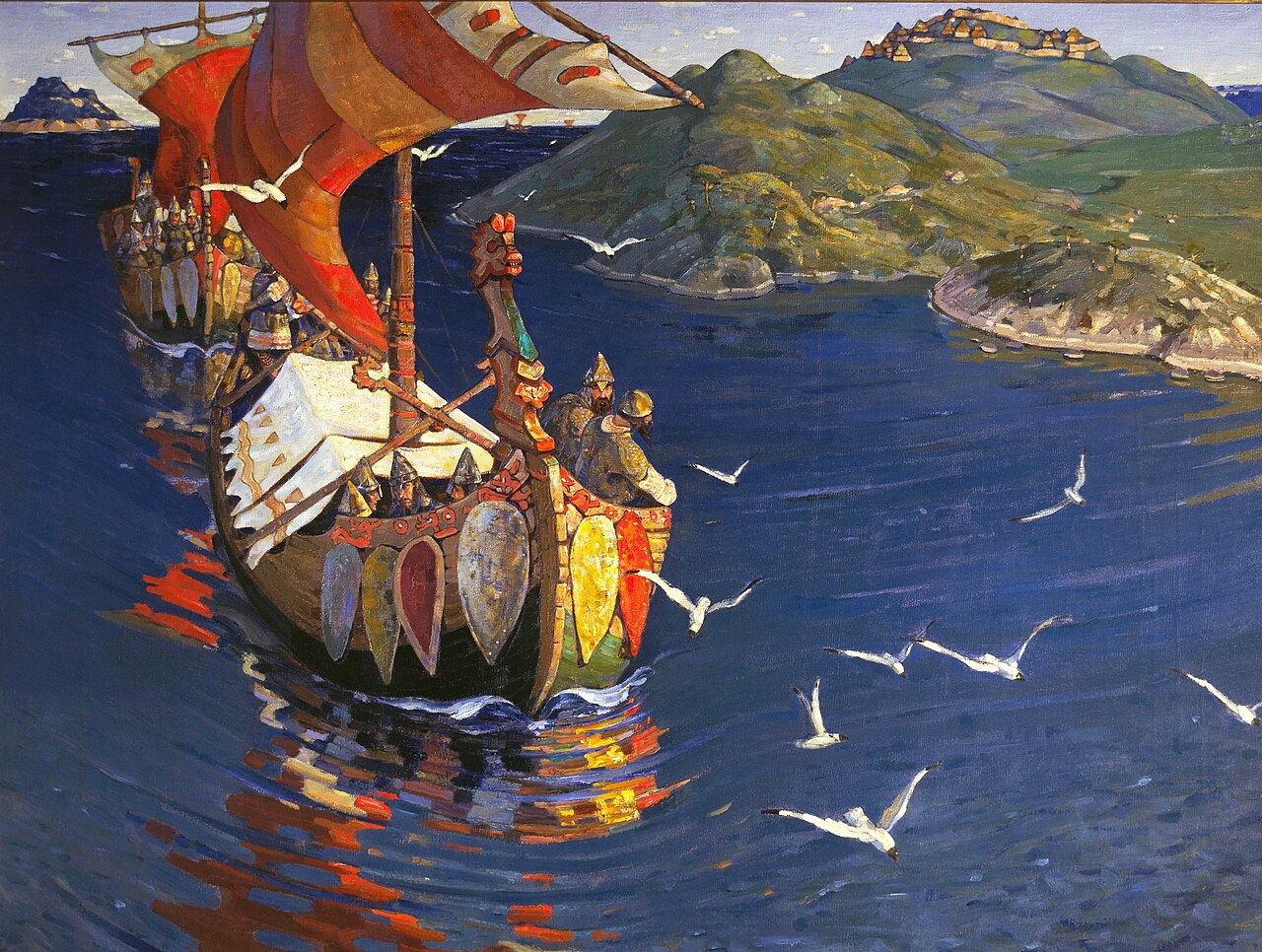
Varangian (Rus) longships sailing along the river route — Nicholas Roerich's 1901 painting Guests from Overseas. (Nicholas Roerich (1874–1947); Public domain; Wikimedia Commons)
The name
The name Varangian comes from Old Norse væringi, 'sworn companion' — a compound of vár ('pledge, faith') and gengi ('companion'). Among the peoples of the eastern routes it denoted Scandinavians who travelled in oath-bound armed trading companies.
The Volga trade route
The Volga route took shape by the early 9th century (with trading traces from the late 8th): from the Baltic through Ladoga (Old Norse Aldeigjuborg) and Novgorod, ships were portaged to the Volga headwaters and sailed downriver — through Volga Bulgaria and the Khazar capital Atil — to the Caspian, whence caravan roads led to Baghdad.
Northern goods moving south were beaver and black-fox furs, honey, wax, slaves, amber, Frankish swords and walrus ivory; south to north flowed Arab silver dirhams and silk. The coin evidence dates the route's operation to roughly 786–1009; over 100,000 Arabic coins have been found in Scandinavian hoards. The route lost its importance in the 11th century, when the Abbasid caliphate's silver output collapsed.
Volga Bulgaria: meeting the peoples of the Volga
The route's central middleman was Volga Bulgaria — a Turkic-speaking state at the confluence of the Volga and the Kama, the forerunner of the Kazan Tatars. Its cities Bolgar and Suvar lived on brokerage: the Varangians brought their furs and slaves there, and silver moved north. When Volga Bulgaria adopted Islam in the early 10th century, the silver-rich Samanid realm lay beyond the Bulgars for merchants of other faiths.
In 921–922 Caliph al-Muqtadir sent an embassy to Volga Bulgaria; its member Ahmad ibn Fadlan wrote an account of the journey. His description of the 'Rūs' he met on the Volga — their trade, customs and ship burial — is one of the earliest portrayals of Vikings anywhere. The most famous portrait of the Volga Vikings was thus written in Arabic, in the land of the Tatars' ancestors.
The Eastern Way and Estonia
The Scandinavians called the waterways east of the Baltic the Eastern Way (Austrvegr). It ran along the northern Estonian coast: travellers put in at harbours under the protection of the strongholds of Rävala and Virumaa. The Estonian lands were fully part of the network — the most Arabic dirhams have been found in Sweden (mostly Gotland), but second in the world is Estonia: from the 10th century alone over thirty Arabic coin hoards are known, the richest find area being Virumaa.
The Rus' state and the Varangian Guard
Statehood also grew out of the eastern routes: by the chronicle tradition the Varangian Rurik settled Novgorod in 862 and Oleg took Kiev in 882, founding Kievan Rus'. In Constantinople, Varangians served from the 10th to the 14th century as the emperors' bodyguard — the Varangian Guard. By the late 11th century the Scandinavian influx east ceased, and the Varangians assimilated into the local Slavic world.
Why this story belongs in this knowledge base
A thousand years ago the Volga Vikings' route already joined the very two endpoints between which the Estonian Tatars' story runs: the Volga region, from which the Mišär merchants set out in the 19th century, and the Estonian coast, where they made their home. And the Islam that Volga Bulgaria adopted in 922 is the same religious tradition the Estonian Tatar congregations carried in Narva and Tallinn.
See also
Sources: the Wikipedia articles 'Varangians', 'Volga trade route' and 'Volga Bulgaria'; treatments of Ahmad ibn Fadlan's travel account.