The Cumans of Hungary (kunok)
The Cumans of Hungary (Hungarian kunok, singular kun) are the westernmost branch of the Kipchak-Cuman tribes — descendants of the same steppe people whose language the Codex Cumanicus records and whose closest living heir is the Mišär language. While on the Volga the Cuman language line lived on, in Hungary the language died out — but the people and their land, Kunság, remain to this day.
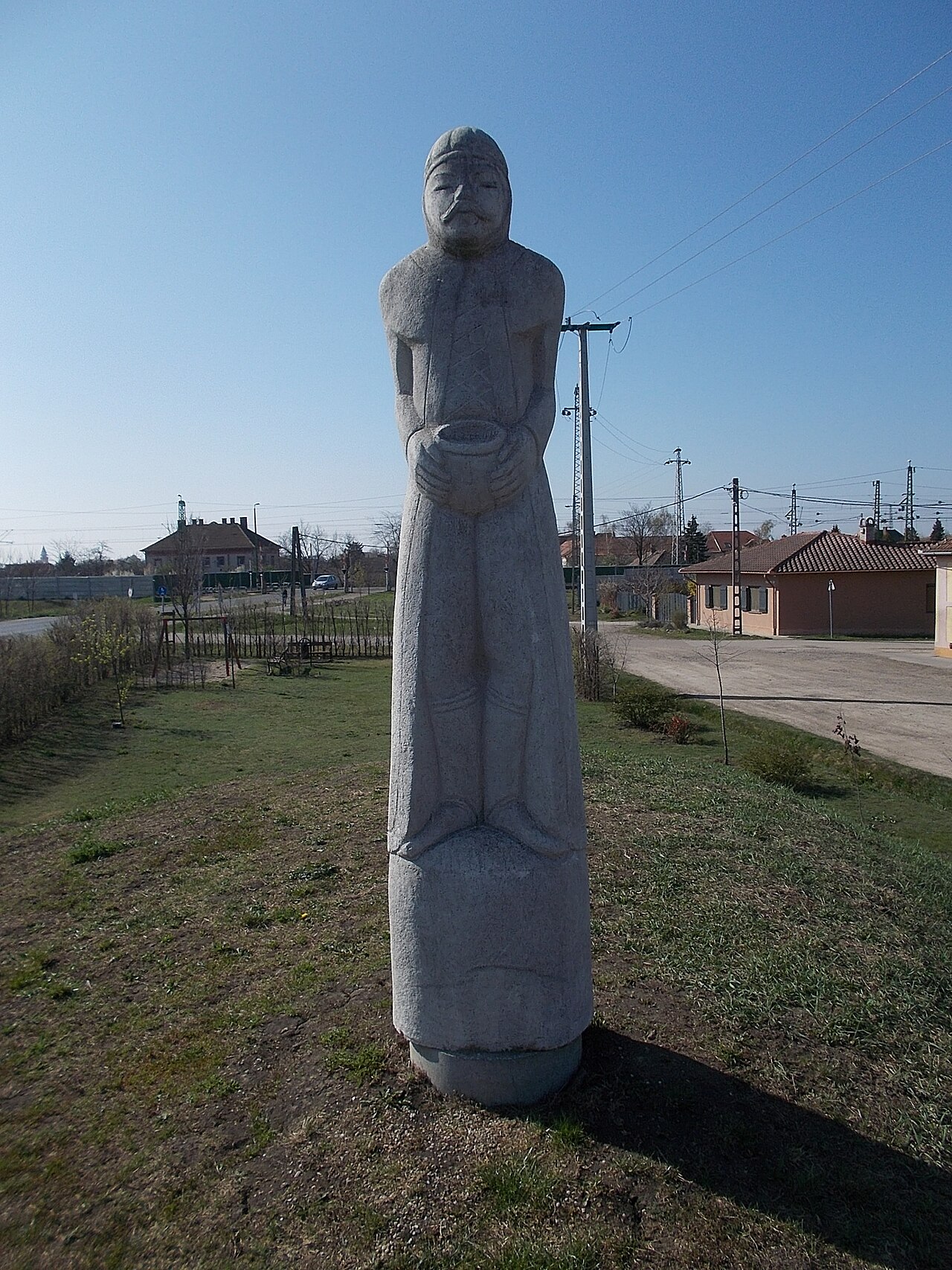
Kunbaba, a stone statue honouring Cuman heritage, standing on an earthen mound near Mezőtúr in the Kunság region of Hungary. (Globetrotter19 (photo); sculpture by Sándor Györfi; CC BY-SA 3.0; Wikimedia Commons)
The flight west (1223–1246)
After the defeat by the Mongols at the Kalka (1223) and the Golden Horde's advance, the Cuman steppe confederation broke apart. In 1239 the Hungarian king Béla IV invited Khan Köten and his people into Hungary — the famed cavalry was seen as a reinforcement of the frontier. A plot of Hungarian nobles had Köten murdered in 1241 and the Cumans left for the Balkans; after the Mongols' devastating invasion Béla IV called them back in 1246. By tradition, 40,000–70,000 Cumans settled in Hungary, divided into seven tribes.
Kunság — the Cumans' land
The Cumans received their own territory on the Great Hungarian Plain: Kiskunság (Little Cumania) in the south and Nagykunság (Greater Cumania) in the northeast. In 1279 King Ladislaus IV — himself the son of a Cuman mother, nicknamed Kun László — codified the Cuman laws: self-government, tax exemptions and military duty. The autonomy lasted centuries: in 1745 the Cumans and the Jász bought themselves out of serfdom under Maria Theresa (the redemptio); Kunság's special status was finally abolished only on 19 June 1876.
The fading of the language
Hungary's Cumans were Christianised and merged linguistically into the Hungarians: the Cuman language died out in Hungary by the early 18th century. Tradition holds the last speaker was István Varró of Karcag († 1770), who at the request of the historian Adam František Kollár recited the Lord's Prayer in Cuman — the recorded form already heavily blended with Hungarian. That same Cuman Lord's Prayer (Kun Miatyánk) lived on in nearly a hundred variants and was still taught in the schools of Kisújszállás and Karcag until 1948.
The link to us
The Cumans of Hungary and the Mišärs are two ends of the same Kipchak-Cuman world: they went west before the Mongols, our ancestors stayed on the steppe and by the Volga. In Hungary the language vanished, but in the Volga villages that same language line lived on — as Mišär, the language this project preserves. Today the people of Kunság (Karcag, Kiskunfélegyháza and others) are linguistically fully Hungarian, yet carry a regional Cuman identity to this day.
The settler numbers (40,000–70,000) are traditional and vary between sources; the story of István Varró as the “last speaker” is a tradition, and the prayer text recorded from him in 1744/1770 is judged by linguists to be a Hungarian-Cuman blend rather than pure Cuman.
See also
Sources: Wikipedia “Kunság”, “Cumans”, “Cuman language”, “Cuman laws”; Hungarian Conservative (“Cumans in Medieval Hungary”; “Regions of Hungary — Kunság”); “Disappearing People and Disappearing Language: The Cumans in Hungary and the Cuman Language” (ResearchGate).