Desecrated sacred sites in Estonia
Estonia's sacred sites — churches, synagogues, prayer houses, mosques, monasteries and natural holy places — were desecrated by the two occupations of the 20th century. The Soviet occupation (1940–1941 and 1944–1991) did so in two ways: through direct wartime destruction — above all the 1944 bombings of Tallinn and Narva — and through a peacetime campaign of state atheism that nationalised church property, dispersed congregations and turned houses of worship into gymnasiums, warehouses and studios. The Nazi German occupation (1941–1944) brought combat destruction and the requisitioning of buildings, and — most gravely — the annihilation of Estonia's Jewish community, which left the synagogues without their people.
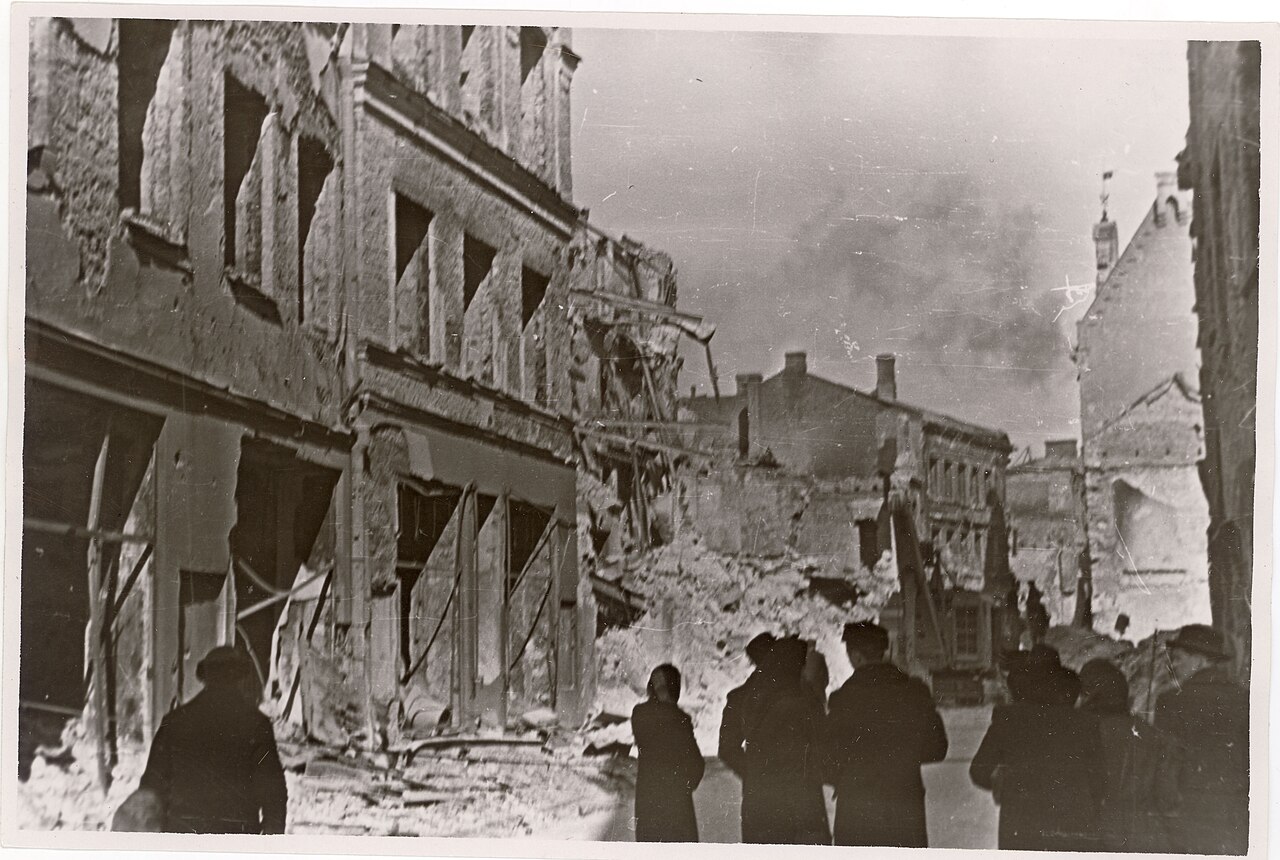
Harju Street in Tallinn's old town lies in ruins after the March 1944 Soviet bombing, which also gutted the nearby Niguliste (St Nicholas) church (Unknown author (Tallinn City Archives / Tallinna Linnaarhiiv); CC BY-SA 4.0; Wikimedia Commons)
The framework of state atheism
A law of December 1940 stripped the churches of their rights: religious education in schools, children's and youth work, charity, mission and publishing were banned, and church property was nationalised; the University of Tartu's faculty of theology was closed on 31 August 1940 and the newspaper “Eesti Kirik” was shut down on 27 August 1940. The first year of occupation and the June 1941 deportations alone cost the Estonian Evangelical Lutheran Church 24 active clergy and many lay leaders and church musicians. Across the whole of the Second World War the Lutheran Church lost about 160 clergy and nearly 24 church buildings.
After the occupation was re-imposed in 1944, the administrative strangulation of congregations continued: children's religious instruction was banned in 1949, operating permits were left unrenewed, and many branch churches never got their permits back. In the 1960s the occupation authorities set out to close the congregations for good within about a decade — a plan that nonetheless failed. The number of confirmands fell to a low (481 in 1978) and rose sharply as the occupation collapsed (11,536 in 1990).
The Orthodox Church too was subordinated: on 24 February 1941 the autonomy of the Estonian Apostolic Orthodox Church (EAÕK) was liquidated and it was merged into the Moscow Patriarchate; in 1944 the metropolitan and synod went into exile (some 8,000 believers and around twenty clergy), and on 16 April 1945 the subordination to Moscow was completed. The Catholic Church was struck through its leadership: the apostolic administrator, Bishop Eduard Profittlich, died in a Soviet prison camp in 1942, foreign priests were expelled, and essentially only the Tallinn and Tartu congregations remained. (See: Orthodoxy under the occupation.)
The Nazi German occupation (1941–1944)
The Nazi German occupation permitted more church life than the Soviet regime — the teaching of theology resumed in Tartu in February 1943 — and damage to churches came mainly from combat and the requisitioning of buildings. Gravest of all, however, was the annihilation of Estonia's Jewish community: most of the community (some 4,000–5,000 people) fled east, those who remained were killed by the end of 1941, and at the Wannsee Conference in January 1942 Estonia was declared “Judenfrei”. Thus the synagogues and prayer houses stood emptied of their people even before the buildings were destroyed in 1944.
Among individual buildings, the clearest cases are:
The Tallinn Great Synagogue — the German occupation authorities converted it into a military warehouse in 1941 (the building itself was later destroyed in the March 1944 bombing — see below).
The Tartu Old Believer prayer house — its bell tower, library and iconostasis were destroyed in the bombing of 12 July 1941.
Anseküla church on the Sõrve peninsula is a clear two-occupation case: retreating Soviet troops set the tower alight in 1941, then in the autumn of 1944 the German occupation force used the stone church as an ammunition store and it took a direct hit from the advancing Red Army. It was never rebuilt — only a foundation level with the ground remains.
The Estonian Apostolic Orthodox Church's brief return under the Ecumenical Patriarchate of Constantinople also took place during the Nazi German occupation (1942–1944), until the German retreat cut it off again.
The bombing of 1944
On 9–10 March 1944 the Soviet air force bombed Tallinn (~300 aircraft, over 3,000 bombs); saboteurs had first knocked out the water pumping station. That same Soviet air force was supplied in significant part by the Western Allies under Lend-Lease. Niguliste (St Nicholas') Church also burned in the fire, its entire medieval interior practically destroyed; it was slowly restored and reopened as the Niguliste Museum and concert hall, no longer a parish church.
The historic centre of Narva was destroyed by Soviet long-range aviation in March 1944 (on the nights of 6–7 and 7–8 March) and the summer battles. Among the houses of worship destroyed:
Narva St Peter's Church — the ruins, their roof wrecked in the 1944 bombing, were demolished after 1953 and the stones reused to build the Narva railway station; the church was never rebuilt.
Narva St John's Church — destroyed in 1944.
Narva Alexander's Great Church — on 6 March 1944 a shell pierced the dome, and on 24 July 1944 the remaining tower was blown up during the capture of the town; the surviving shell was later put to a new use (see below).
Narva's Tatar mosque (see below) and synagogue were destroyed in the same devastation.
Churches into gyms and granaries
Churches that survived were adapted by the occupation authorities to secular use — gymnasiums, warehouses, clubs, studios. Examples:
Tartu St Mary's Church — the ruins, destroyed in the 1941 bombing, were handed to the Agricultural Academy in 1956, and in 1961 a gymnasium was opened in the building and the remaining tower demolished. The congregation regained the building only after its restoration (the tower was reconsecrated on 29 February 2024).
Rakvere St Paul's Church — the congregation was liquidated in 1951 and the church became a gymnasium.
Uulu Church (Pärnu county) — first a grain store, then collective-farm parties, then a gymnasium; restored as a place of worship in 2007.
Tallinn Bethel Church (Peeteli) — the congregation was closed in 1962 and the building given to Eesti Telefilm as a film studio (the windows were bricked up).
Swedish St Michael's Church (Rootsi-Mihkli, Tallinn) — a weightlifting hall was built inside it.
Halliste Church — after a fire in 1959 the local sovkhoz management planned to turn it into a culture house and sports club.
Narva Alexander's Great Church — the congregation lost the war-damaged shell on 2 September 1962 and a retail-goods warehouse was installed inside; the building was returned in 1990 and the tower, with a museum, opened in 2008.
Angerja Orthodox Church — the congregation gave up the building in 1949 and the church was closed on 22 November 1951; during the occupation it served as a vegetable store and then a Tallinnfilm warehouse, its stoves demolished. It was restored as a place of worship in 1994.
Orthodoxy and monasteries
The closure of Orthodox parishes was most extensive during Khrushchev's anti-religious campaign of 1960–1964. Tallinn's Alexander Nevsky Cathedral was never demolished: the demolition proposals belonged to the debate of the 1920s–30s in independent Estonia (and were never carried out), while during the occupation the cathedral was preserved. (See: Orthodoxy under the occupation.)
The Pühtitsa (Kuremäe) Orthodox Convent (founded 1891) was one of only two monastic houses in the entire Soviet Union that never ceased activity in the 20th century (the other was the Pskov-Caves Monastery). Khrushchev's campaign threatened it too: the decrees of 5 November 1958 quadrupled the convent's tax burden (by the end of 1959 more than 200,000 roubles a year, about 56% of its income) and a miners' rest home was planned for its site. The convent survived, but its Tallinn branch church was closed in 1959 and demolished in 1960.
Old Believers on Lake Peipsi
The prayer houses of the Old Believers of the Lake Peipsi shore (Kolkja, Varnja, Mustvee, Kallaste, Kasepää, Piirissaar, Raja, Kükita) were hit in several ways. Soviet forced collectivisation cut through the villages' economic foundation, and repression struck the congregations' leaders: the Mustvee leader A. Gužov was deported and died in a Leningrad prison, after which services were held secretly in private homes. In the fighting of the Nazi German occupation the Raja prayer house burned on 30 August 1944 (its library, founded in 1718, was partly saved), and the Tartu prayer house lost its bell tower, library and iconostasis in the 1941 bombing.
Synagogues
Before 1940 Estonia had two monumental synagogues — in Tallinn and Tartu — and smaller prayer houses in Narva, Pärnu, Valga, Viljandi and Võru.
The Tallinn Great Synagogue (Maakri Street, in Moorish/neo-Romanesque style, architect Nikolai Thamm Sr, consecrated 1885) was converted into a military warehouse under the Nazi German occupation in 1941 and destroyed in the March 1944 bombing; the ruins were demolished in 1947. Tallinn had no synagogue for nearly 60 years — the new one (Beit Bella, Karu Street) opened on 16 May 2007.
The Tartu Synagogue (architect Robert Pohlmann, consecrated 15 June 1903) was destroyed in 1944. Its ritual objects were rescued by Uku Masing and Paul Ariste — 132 items are kept in the Estonian National Museum. Residential buildings were put up on the site in the 1960s; a memorial plaque was unveiled in June 2023.
The Jewish communities of the smaller towns (Narva, Pärnu, Valga, Viljandi, Võru) were annihilated in 1941 and their prayer houses did not escape the war; the common thread was the destruction of the communities themselves, not merely the loss of buildings.
Mosque and Muslim prayer houses
The Narva Muslim Congregation was registered in 1928 — the first Islamic congregation of the Republic of Estonia. It bought a house on Kiriku (Church) Street and converted it into a mosque, which became a centre of Tatar identity. In 1934 the émigré imam Alimcan İdris visited the congregation and praised Estonia's constitution for the equal rights it granted to minorities. The Tallinn Muslim Religious Society was registered in 1939. After the 1940 occupation the occupation authorities banned the activity of both congregations, and in 1944 both the Narva mosque and the premises of the Tallinn prayer house were destroyed. The community kept the faith underground until the re-registration of the Estonian Islamic Congregation in 1990 — the direct legal successor of the pre-war congregations.
Sacred groves and natural holy places
Estonia has at least about 550 sacred groves (hiied) and some 2,000 other natural holy places (springs, sacrificial stones, sacred trees). The occupation authorities treated them with indifference and at times malice; forced collectivisation destroyed the farm-based care that had protected them for centuries, and many groves were abandoned in the 1960s. Concrete losses:
The Tammiku (Jõhvi) grove — most of the oak grove was buried under the spoil heap of an oil-shale mine; only a few ancient sacred oaks survived.
The Sipa grove (Kullamaa) — collective-farm barns and manure stores were built in the sacred grove.
The Karkuse sacred hill (near Tapa) — largely destroyed by gravel extraction.
The Arstikivi (healing stone) — in the 1980s a collective farm wanted to move the sacred stone; a local man, Viktor Jaave, defended it so stubbornly that the stone was spared.
Cemeteries
The occupation authorities took over Tallinn's cemeteries in 1944, preserving the Orthodox ones and erasing those of the minorities: Kopli and Mõigu (Baltic German) were levelled around 1950–51, Kalamaja in the 1950s–60s, the old Catholic cemetery in 1955 and the old Jewish cemetery in 1963; the Tatar cemetery was destroyed as well. (See: No one escaped the Soviet Union, The destruction of sacred sites and cemeteries in the Soviet Union.)
Restoration as the occupation collapsed
As the occupation collapsed (1988–1991), the national awakening was followed by a religious revival: banned associations were restored (the Estonian Islamic Congregation in 1990), religious education returned to schools as an elective in 1991, Tallinn's new synagogue opened in 2007, and the tower of Tartu St Mary's Church was reconsecrated in 2024. Many churches were returned to their congregations, though some still bear the marks of the occupation.
The link to our story
The religious life of the Estonian Tatars suffered the same blow: the Narva mosque and the Tallinn prayer house were destroyed, the congregations banned and the Muslim cemetery destroyed. The community kept its faith underground until 1990 — the desecration of holy places is part of the same story of occupation that touched every religious and ethnic group in Estonia.
Note: this list is not exhaustive. If you know of a desecrated or destroyed sacred site not yet listed here, please send us the information — you will help complete and preserve this history. Get in touch via the contact page.
See also
Sources: okupatsioon.ee — religion; EELK, “Eesti Kirik läbi aja”; the March bombings of Tallinn and Narva (Wikipedia; National Archives/Tuna); Sirp, “Kirikud — üleliigne hooneliik?”; the Maakri Street Synagogue and Tartu Synagogue (Wikipedia); Tartu St Mary's Church, Narva St Peter's Church, Narva Alexander's Great Church (Wikipedia); EAÕK — history of the Angerja congregation (eoc.ee); Pühtitsa Convent (puhtitsa.ee); Estonian Old Believers and the Peipsi Region Museum; Islam in Estonia and the Estonian Islamic Congregation (Wikipedia; eestitatarlased.ee); Hiite Maja / Maavalla koda; the Catholic Church in Estonia (Wikipedia).