The destruction of sacred sites and cemeteries in the Soviet Union
The destruction of the Estonian Tatars' Muslim cemetery was not a local exception but part of a policy that spanned the whole Soviet Union. Nothing was sacred to the Soviet occupation authorities: the same pattern — close a cemetery, level it, cover it with a park, a stadium or a road, reuse the headstones as building material — repeated from Moscow to Vilnius. This page gives the Union-wide background within which Estonia's cemetery story sits.
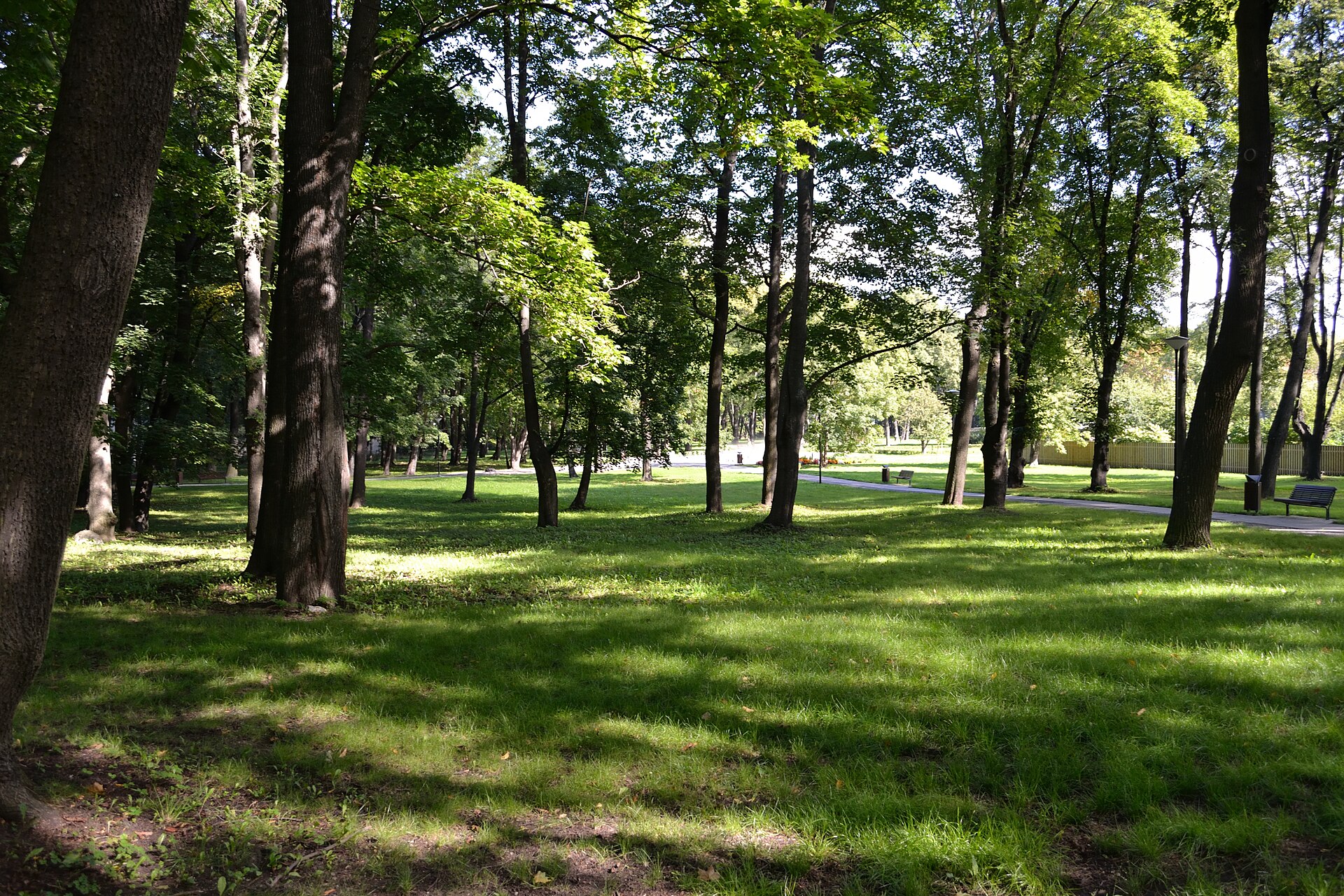
The Kalamaja cemetery grounds in Tallinn — one of many cemeteries destroyed during the Soviet occupation. Photo: Iifar (CC BY-SA 3.0 ee), Wikimedia Commons.
The antireligious campaigns
The destruction of cemeteries went hand in hand with the suppression of religion. Before 1917 the Russian Empire had over 50,000 Orthodox churches (one count gives 29,584 in 1927); after the Stalin-era campaigns (1928–1941) fewer than 500 were still functioning across the entire USSR. After a partial wartime recovery, Khrushchev's campaign (1958–1964) closed roughly half of them again: about 22,000 (1959) fell to some 7,800 (1965). There had been over a thousand monasteries before 1917 — by 1965, 17 remained. Mosques were closed too: 3,567 in Uzbekistan alone.
“Parks of culture and rest”
Turning cemeteries into parks was a Union-wide practice. In the 19th century Moscow had more than 300 graveyards; most were demolished in the first decades of Soviet rule. The Lazarevskoye cemetery became a children's park, with most graves simply left under the turf. The Simonov Monastery graveyard was cleared for a motor plant and tramway; the headstones were reused as street paving and as marble cladding in Metro stations — exactly as the stones of Tallinn's razed cemeteries were carted to Russalka for coastal reinforcement. The Novodevichy convent's 19th-century necropolis (about 2,000 graves) was largely destroyed.
Jewish cemeteries — the best-counted subset
The one category of cemetery for which large-scale surveys exist is Jewish cemeteries, thanks to the work of Western and Israeli organisations (ESJF, USCPAHA, Yad Vashem) after 1991. Some 10,000 Jewish cemetery sites are known in Europe, nearly three-quarters of them in Central and Eastern Europe — the former Soviet bloc. ESJF estimates that about a quarter of Eastern Europe's Jewish cemeteries were destroyed under Nazi and Soviet rule; ESJF has mapped 4,140 cemeteries in ten countries between 2017 and 2025. A Ukrainian heritage survey counted 731 cemeteries and 495 mass graves.
Clearly Soviet (not Nazi) destructions: the old Jewish cemetery at Šnipiškės in Vilnius was closed in 1955–56 for a swimming pool and covered by a Palace of Sports in 1971; the Užupis cemetery in Vilnius (some 70,000 burials) was demolished in 1965 and its headstones made into stairways; the old Jewish cemetery in Minsk was built over by the Dinamo stadium in 1934.
The Baltic states under the occupation
In the Baltics there was an added motive: erasing the traces of the Baltic-German and national past. The direct twin of Tallinn's Kopli cemetery is Riga's Great Cemetery (Lielie kapi) — the largest Baltic-German burial ground, where burials ended in 1957 and which was bulldozed into a public “memorial park” in 1967–69; about 14,000 gravestones were warehoused. In Lithuania the loss centres on the Jewish cemeteries of Vilnius. The same pattern struck Kopli, Kalamaja and Mõigu in Estonia.
Forced reburials
When a cemetery was liquidated, usually only a few “famous” remains were reburied; the rest were left under the new construction. Nikolai Gogol was exhumed from the Danilov Monastery in 1931, Sergei Aksakov from Simonov in 1930. At Kopli in Tallinn, only a handful of people were reburied from an entire cemetery. By the same logic, the remains from Tallinn's Tatar cemetery were moved to Liiva cemetery in the late 1950s.
Note
No single Union-wide total of destroyed cemeteries exists — the occupation authorities kept no such tally, and the destruction unfolded over 70 years through many channels. Churches and monasteries are countable, and Jewish cemeteries partly so; ordinary municipal cemeteries were never counted. The direction is clear: dozens in Estonia, thousands across the Soviet Union. Estonia's list is a representative part of this Union-wide pattern, not an exception.
See also
Sources: Soviet antireligious campaign 1958–64; antireligious campaign 1928–41; ESJF (European Jewish Cemeteries Initiative), ESJF surveys; US Commission for the Preservation of America's Heritage Abroad; Novodevichy Cemetery; Jewish cemeteries of Vilnius; Great Cemetery of Riga; Kopli cemetery (Wikipedia); the vanished cemeteries of Tallinn (Estonian World).