Why the Soviet Union destroyed cemeteries
The Soviet occupation razed, closed and built over hundreds of cemeteries in Estonia and across the whole Soviet Union — in Estonia and Union-wide. Why? No document says “we are destroying this cemetery because of ideology X”. The motives are reconstructed by historians and heritage scholars from the pattern of what was destroyed, what replaced it, and the policy around it. Six reasons emerge.
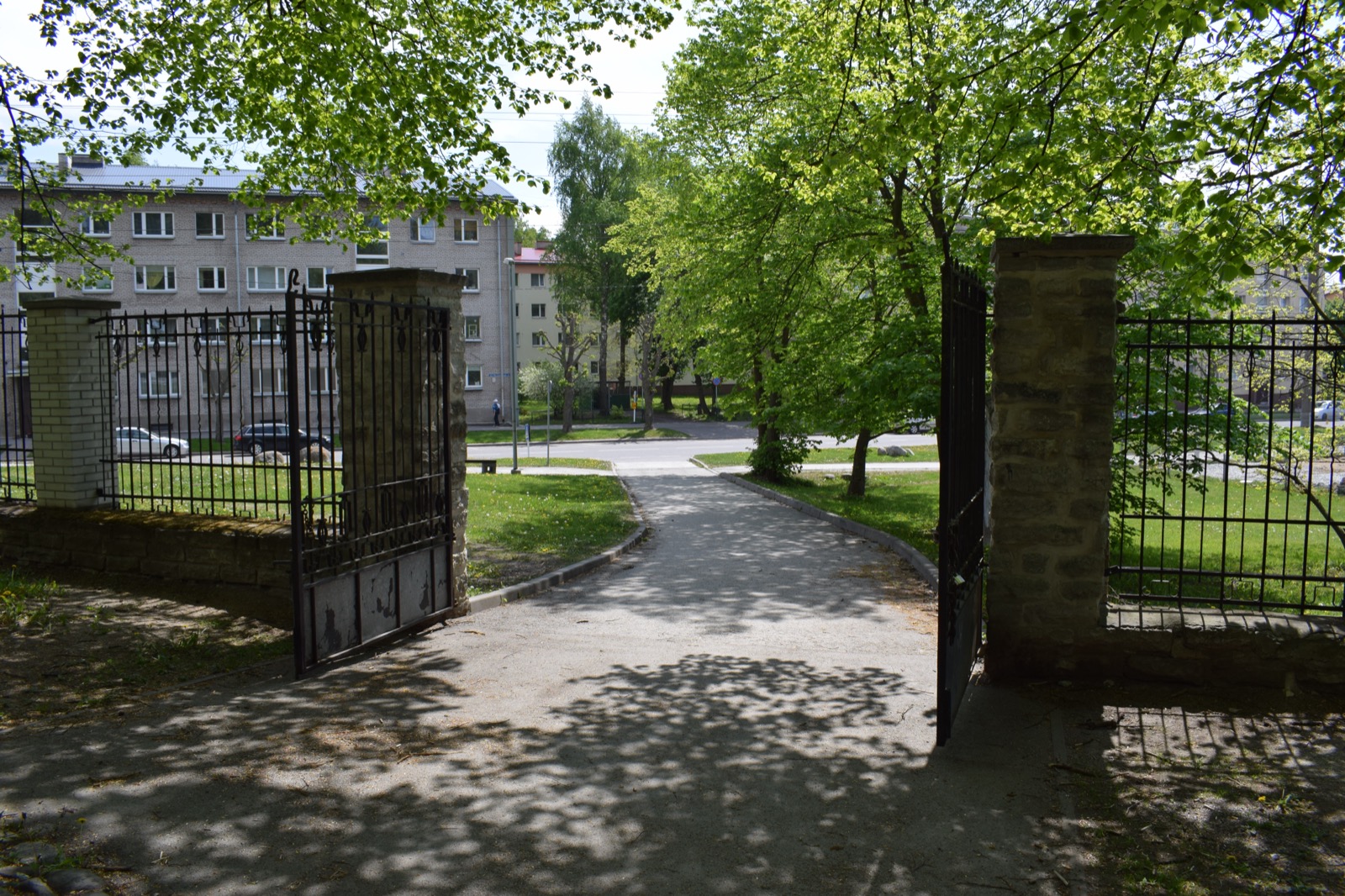
The Kopli cemetery park — a park laid out over a destroyed cemetery. Photo: Erko, 2017 (CC BY-SA 4.0), Wikimedia Commons.
1. Militant atheism
The Bolshevik state treated cemeteries as consecrated church property to be nationalised. The 1918 Decree on the Separation of Church and State stripped religious bodies of ownership and placed all cemeteries and all funeral organisation under local Soviet control — burial was taken from the Church and made a secular state function. The state promoted a secular death-culture: cremation, which the Orthodox Church forbade, was state-sponsored from 1919. Consecration itself was treated as revocable — at Moscow's Donskoye cemetery in 1930 former Orthodox consecrated ground was deliberately chosen for a mass grave of the executed, because state atheism had “revoked” its sanctity. The League of Militant Atheists (from 1925) drove the wider campaign that cut the list of protected churches from about 7,000 to 1,000. Atheism supplied the legitimating logic: a graveyard was not sacred, merely land the state now owned. See Orthodoxy under the occupation.
2. Erasing the “bourgeois” past
Old cemeteries were, physically, monuments to the pre-revolutionary social order — the nobility, clergy, officers and merchants who became the persecuted “former people” after 1917. Class war was theorised as an escalating struggle in which the enemy had to be “constantly searched out and destroyed”. Family tombs with their heraldic crests embodied exactly the class the state was liquidating. The same ground served the reverse purpose: in the cities the security services used unmarked graves inside existing cemeteries to dispose of Great-Terror victims (at least ~680,000 executed in 1937–38 alone). The motive is strong as ideology, but the direct claim “we razed it because the cemetery was bourgeois” is largely inferred. See Communist crimes against Estonia's minorities and the cultural genocide of the Estonian Tatars.
3. The “socialist reconstruction” of cities
The best-documented practical-ideological motive. Under the 1935 General Plan for the Reconstruction of Moscow, many historical buildings were demolished and great emphasis fell on creating new parks. Of Moscow's 300-plus 19th-century graveyards most were demolished in the first Soviet decades — about 71 remain today, and many parks and buildings stand on former burial grounds. The reuse was direct and industrial: during metro construction monastery graveyards became building sites, and grubbed-up headstones were used for street paving and as marble cladding in outlying metro stations — exactly as the stones of Tallinn's razed cemeteries were carted to Russalka for coastal reinforcement. The animating idea: burial space was “redundant” land owed to the living. See the destruction of sacred sites and cemeteries in the Soviet Union.
4. Memory politics and de-nationalisation in the Baltics
In occupied Estonia the main motive was erasing the non-Russian, pre-occupation national past. The largest Baltic-German necropolises — Kopli and Mõigu (both 1774) — were flattened around 1950–51, and even the 400-year-old Kalamaja cemetery (with Estonian and Swedish graves) was levelled in 1964 and turned into a park. The same logic struck Estonian national memory too, not only German: the occupation authorities destroyed War of Independence (1918–20) memorials because they did not fit the Soviet narrative that cast the war as a class and civil war; Soviet war monuments were often erected on top of earlier graves (the Maarjamäe memorial partly over a German military cemetery). Cemetery destruction here was one instrument of russification and of suppressing national mourning. See Russification and the overview No one escaped the Soviet Union.
5. Practical reuse
Alongside ideology ran a mundane bureaucracy. In Tallinn the liquidation of Kopli and Kalamaja was put on the agenda in 1940 and the executive committee declared the cemeteries “closed” in 1941 — “closed cemetery” status was the bureaucratic gateway to clearance and reuse. Once closed, the physical fabric was harvested: the dismantled parts of Kopli and Mõigu went into port and coastal walls, and a beer hall with a dance floor was built over Kopli. The same headstones-as-cheap-material logic recurred across the western USSR, most starkly with Jewish cemeteries: the Užupis cemetery in Vilnius (some 70,000 buried) was demolished under the occupation in the 1960s and its stones built into a stairway to the trade-union headquarters. Little ideology, much practice: free land, free stone, one fewer religious institution — but this is what physically executed the higher motives. See Kopli cemetery.
6. Scholarly framing: memoricide
Heritage and memory scholars name the pattern directly. The concept of memoricide — “the killing of memory”, the deliberate wiping-out of a people's past and presence through the destruction of heritage — is the umbrella term. A 2024 study shows how destruction was recoded as “improvement”: razing minority and religious cemeteries was reframed as “cultivating” redundant terrain — the same logic that turned a graveyard into a “park of culture and rest”. More broadly, the cultural-genocide literature places Soviet cultural destruction in the frame of manufacturing the “New Soviet man” by liquidating rival pasts. See the cultural genocide of the Estonian Tatars.
In sum: the Estonian case
In occupied Estonia, cemetery destruction was less about atheism than about memory: the occupation authorities razed Baltic-German, Estonian and Swedish burial grounds — and the Republic's War of Independence memorials — to erase the physical evidence of a non-Russian, pre-occupation national past that contradicted the Soviet narrative of Estonia as a class-struggle republic. That ideological erasure was carried out through an ordinary bureaucratic pipeline — declare a cemetery “closed”, clear it, reuse the stone for coastal walls and the land for a park, a beer hall or a military zone — so a single act served de-nationalisation, secularisation and cheap construction at once. Destroying a community's dead is erasing its presence.
Note
In almost no case did the occupation authorities state in a document that they were destroying for ideology. The justification on the ground was usually banal — sanitation and the reuse of “closed/full” cemeteries. The deeper motives are read out of the pattern of which cemeteries were chosen and what replaced them.
See also
Sources: Decree on the Separation of Church and State (1918); Soviet anti-religious legislation; League of Militant Atheists; “Former people”; General Plan for the Reconstruction of Moscow (1935); the vanished cemeteries of Tallinn (Estonian World); Soviet war monuments in Estonia (database); Kopli cemetery (Wikipedia); memoricide (SSRC); A History of Overwriting (2024); cultural genocide.