The Burtas
The Burtas were a medieval people of the middle Volga who lived on the river's right bank roughly between Volga Bulgaria and the Khazar Khaganate. They are one of the substrate peoples that fused into the Mišär Tatars in Meshchera — yet their own origin remains disputed to this day.
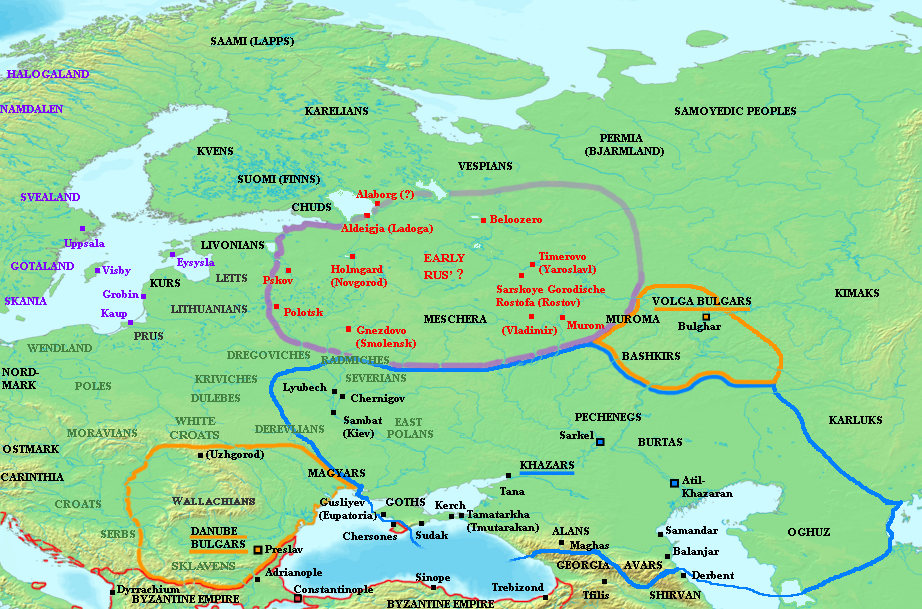
Map of the peoples of Eastern Europe and the middle Volga around 800 CE, with the Burtas, Volga Bulgars, Bashkirs, Khazars and neighbouring tribes labelled in Latin script (Briangotts; CC BY-SA 3.0 (also GFDL 1.2+); Wikimedia Commons)
What we know of the Burtas
We know the Burtas almost entirely through the 9th–10th century Arab and Persian geographers — Ibn Rustah, al-Istakhri, Ibn Hawqal, al-Mas'udi and the circle of Ibn Fadlan's Volga embassy (921–922). Little archaeology is firmly tied to them, which is one reason their picture stays blurred. By the geographers they were a mostly settled farming people who also kept herds and had no single ruler, only local elders.
The backbone of their economy was the fur trade: a prized marten and fox pelt known as “burtasi” was named after them and carried as a luxury down the Volga trade route. They also grew grain, raised cattle and kept bees. Politically the Burtas were subject to the Khazars (the sources say the Khazars could raise about 10,000 Burtas horsemen); after Khazaria's fall they came under Volga Bulgaria's orbit.
The origin debate
The Burtas' linguistic and ethnic affiliation is genuinely disputed — we present all three main views, holding none as proven:
The Finno-Ugric (Mordvin) thesis — the Burtas were a Uralic people later Turkicized, possibly ancestral to the Moksha (Mordvins). The linguist Ashmarin even derived the name Mordva from Burtas.
The Turkic thesis — the Burtas were Turkic-speaking, close to the Volga Bulgars. Argued by the Tatar archaeologist Khalikov and much Tatar scholarship.
The Iranian (Alanic) thesis — the Burtas were an Iranian (Alanic) group; supported by the name's Iranian etymology (Middle Iranian furt “big river” — “river people”).
The sources are often read as describing a mixing population — which is why no single answer commands consensus.
The tie to the Mišärs
The Burtas are regularly listed among the substrate components that fused into the Mišär Tatars in Meshchera — alongside the Kipchaks, the Volga Bulgars, Khazar remnants and the local Finno-Ugric Meshchera-Mordvins. Some scholars go further and derive the Mišärs partly from a Turkicized Burtas population (e.g. Khalikov, deliberately downplaying the Kipchak role). A dedicated study is “Khazars, Kipchaks, Burtas: On the Ethnic Ancestors of the Nizhnii Novgorod Mishar Tatars” (2018).
The Burtas trace reaches straight into our story: by the late 14th century part of them is documented settling in the Temnikov area — exactly where the Mišär ethnic character took shape. This is the same Mišär origin debate that runs through our pages: whether the Mišärs are Turkicized Finno-Ugrians or Kipchak Turks — and the Burtas stand at the centre of it, because their own identity is open.
Sources
This article draws on: Burtas; Mishar Tatars; Meshchera people; Ahmad ibn Rustah (English Wikipedia); “Khazars, Kipchaks, Burtas…” (Anthropology & Archeology of Eurasia, 2018). Russian- and Turkish-language scholarship was read only via English summaries; the origin question is deliberately left open. See also this knowledge base's pages: The Mišärs' road to Tallinn, the Temnikov Principality, Volga Bulgaria and the Khazar Khaganate.