Volga Bulgaria
Volga Bulgaria was a Turkic trading state at the confluence of the Volga and the Kama, lasting from about the 7th–8th century until 1236. It is the direct forerunner of the Kazan Tatars and one of the three great pieces of the pre-Golden-Horde world from which the Mongols fused today's Tatar world.
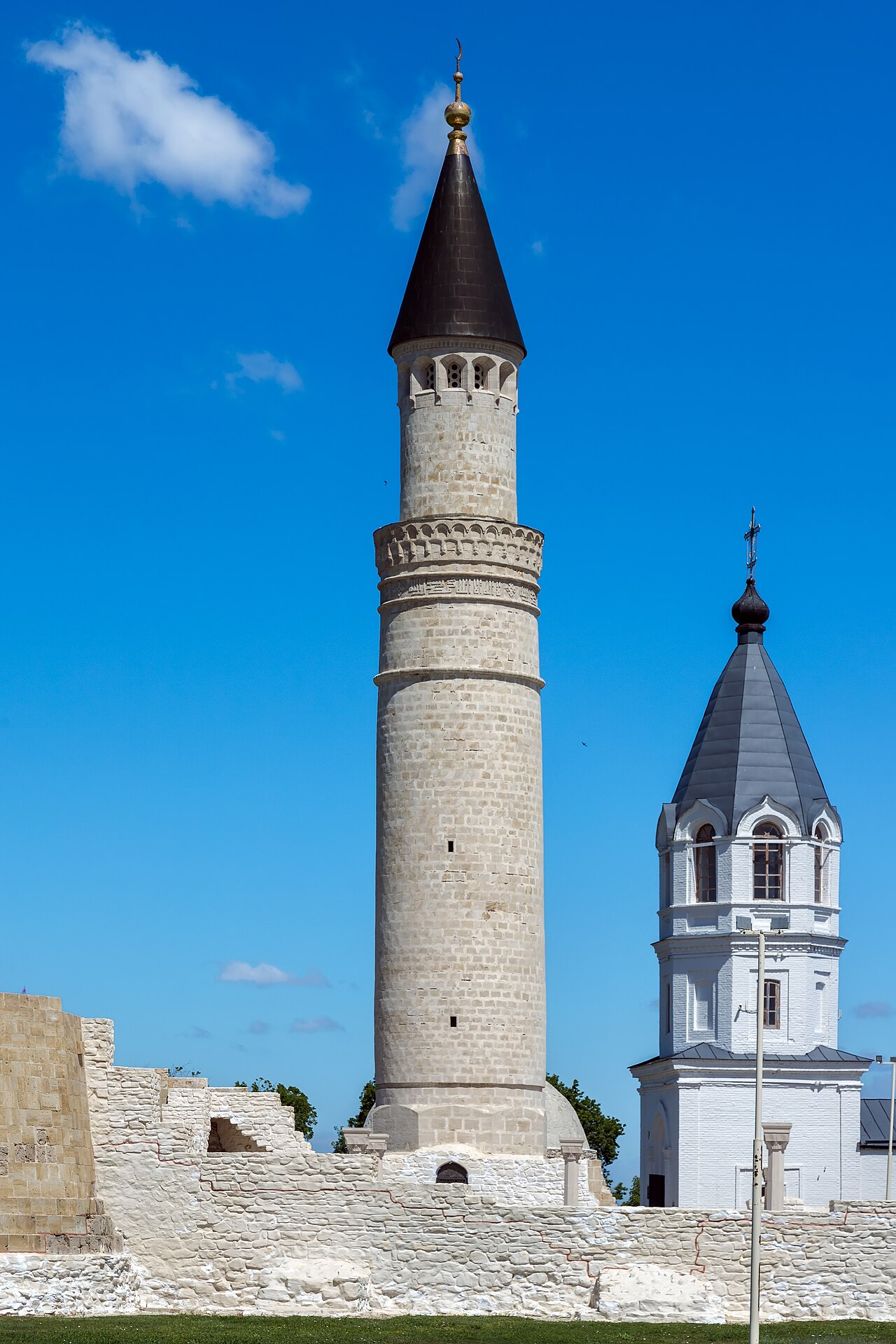
The Great Minaret and the ruins of the Cathedral Mosque at Bolgar, a monument of the medieval Volga Bulgaria capital in Tatarstan (Mike1979 Russia; CC BY-SA 3.0; Wikimedia Commons)
A state on the river
The Bulgars were a Turkic people who migrated from the Black Sea steppes to the middle Volga and mingled with the local Finno-Ugric and Iranian-speaking peoples. The state's centres were the cities of Bolgar and Suvar. Volga Bulgaria lived on brokerage: it controlled the northern stretch of the Volga trade route, channelling furs, honey, wax and slaves from the north to the south and Arab silver to the north.
Islam (922)
In 922 Volga Bulgaria formally adopted Islam. Caliph al-Muqtadir sent an embassy from Baghdad, whose member Ahmad ibn Fadlan wrote an account of the journey — the source, too, of one of the earliest descriptions of Vikings ('Rūs') anywhere. For the Bulgars Islam became both a faith and a commercial bridge to the Muslim world; it is the same religious tradition inherited by the Kazan and Mišär Tatars.
Fall and legacy
In 1236 Genghis Khan's grandson Batu crushed Volga Bulgaria and absorbed it into the Golden Horde. The Bulgar people did not vanish but fused with the Kipchaks who came from the steppes — from that mixture the Volga Tatars grew. The Khanate of Kazan (1438) took over Volga Bulgaria's lands and heritage. Thus Volga Bulgaria is the trunk of the Kazan Tatars; the Mišärs are the western branch of the same wider Volga Tatar world.
See also
Sources: the Wikipedia articles 'Volga Bulgaria' and 'Ahmad ibn Fadlan'. The state's beginning is an estimate.