The life of Muslims in the Soviet Union
The Soviet Union held one of the world's largest Muslim populations — 45–50 million people by the 1980s: Volga Tatars, Bashkirs, the peoples of Central Asia and the Caucasus, and Crimean Tatars. Under state atheism their faith was first crushed and then tightly controlled — yet Islam lived on as identity and custom. For the Estonian Tatars this is the story their homeland lived, while the community's exile branch kept the faith in freedom.
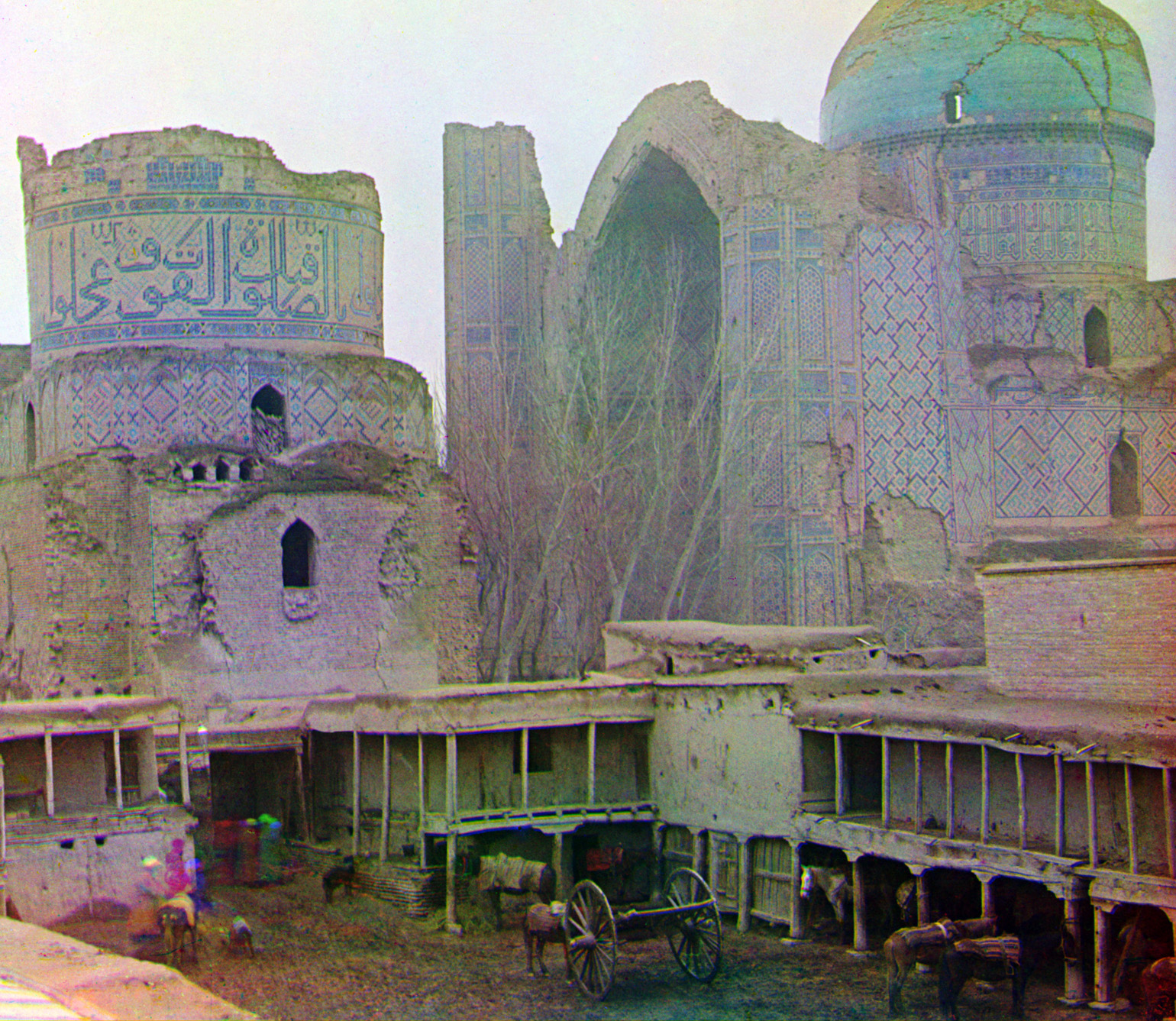
The Bibi-Khanym Mosque in Samarkand, one of Central Asia's largest historic mosques, captured in color before the Soviet occupation (Sergei Prokudin-Gorski; Public domain; Wikimedia Commons)
Early tolerance and the turn (1917–1920s)
At first the Bolsheviks granted Muslims more religious freedom than the tsarist state: on 24 November 1917 Lenin proclaimed that Muslims' “beliefs and practices, national and cultural institutions are forever free and inviolate”. In Central Asia Friday became a day of rest and indigenisation (korenizatsiya) brought locals into power. In the second half of the 1920s Stalin reversed it.
The atheist campaign: mosques, medreses, mullahs
Mosques were closed or turned into warehouses, religious schools (medreses) abolished, religious endowments (waqf) confiscated and sharia courts suppressed. Between 1929 and 1941 the vast majority of the country's mosques were shut: where the former empire had held about 25,000 mosques in 1917, only about 500 remained across the whole Soviet Union by the 1970s. During the Great Terror (1930s) thousands of Muslim clerics were arrested and executed; atheism was spread by, among others, the League of Militant Atheists.
Alphabet reform as a rupture
A blow of its own was the reform of writing. In the 1920s–1930s the scripts of the Soviet Union's Turkic-Muslim peoples were moved from the Arabic alphabet to Latin and, by about 1939, to Cyrillic. Each change severed the tie to the earlier written heritage — the Quran, religious and literary works — which had been written in Arabic letters for centuries. It was part of a wider russification. (The Estonian Tatars' Latin alphabet today is a free choice — not an imposed rupture.)
The hujum: the unveiling campaign
In 1927 the authorities launched the hujum campaign in Central Asia, attacking the women's veil (paranja) and seclusion (pardah) as symbols of oppression. The effect was often the opposite: veiling, which had earlier been more a custom of the wealthier class, became a widespread mark of religious resistance.
The deportation of whole peoples (1943–1944)
During the Second World War Stalin deported whole Muslim peoples to Siberia and Central Asia, citing alleged collaboration with the Nazis. The Crimean Tatars were deported on 17 May 1944 — over 193,000 people in all. By the Soviet authorities' official figures mortality in the first eighteen months was about 20%; by the community's memory and estimates it reached up to 46% — more than double. The same fate struck the Chechens, Ingush, Balkars, Karachays and Meskhetian Turks.
Official and underground Islam (1943→)
In 1943–1944 the state created four Muslim Spiritual Directorates (muftiates) to control Islam: one for Central Asia and Kazakhstan in Tashkent, one for the European part and Siberia in Ufa, one for the Northern Caucasus and Dagestan, and one for Transcaucasia. In 1943–1947 dozens of mosques reopened, but this stayed limited: by the 1980s there were still only about 500 mosques for 45–50 million Muslims. What lived on was parallel or underground Islam — unregistered mullahs, Sufi brotherhoods and the life-cycle rites (naming, marriage, burial) that carried the faith on outside the official walls. The same pressure continues in present-day Russia.
Islam among the Estonian Tatars
In Estonia the Narva Muhammadan congregation was registered in 1928 and the Tallinn one in 1939. After the 1940 occupation the authorities banned the congregations and both buildings were destroyed in 1944. Under the Soviet occupation the community kept Islam unofficially — holding prayers, observing customs and marking the holidays. The branch that fled into exile, however, could keep the faith in freedom. See also the history of Estonia's Muslim Tatars.
Sources: Islam in the Soviet Union (Wikipedia); Religion in the Soviet Union (Wikipedia); Official Islam in the Soviet Union (Bennigsen & Lemercier-Quelquejay); Islam Eestis (Estonian Wikipedia).