The Old Turkic script
The Old Turkic script (also the Orkhon-Yenisei script, or the Turkic runes) is the oldest writing system of the Turkic language — the alphabet in which the Turkic inscriptions of the 8th–10th centuries were set down. For us it is the beginning of Turkic literacy: the oldest script of the family to which Mišär also belongs. The most famous monument written in it is the Orkhon inscriptions.
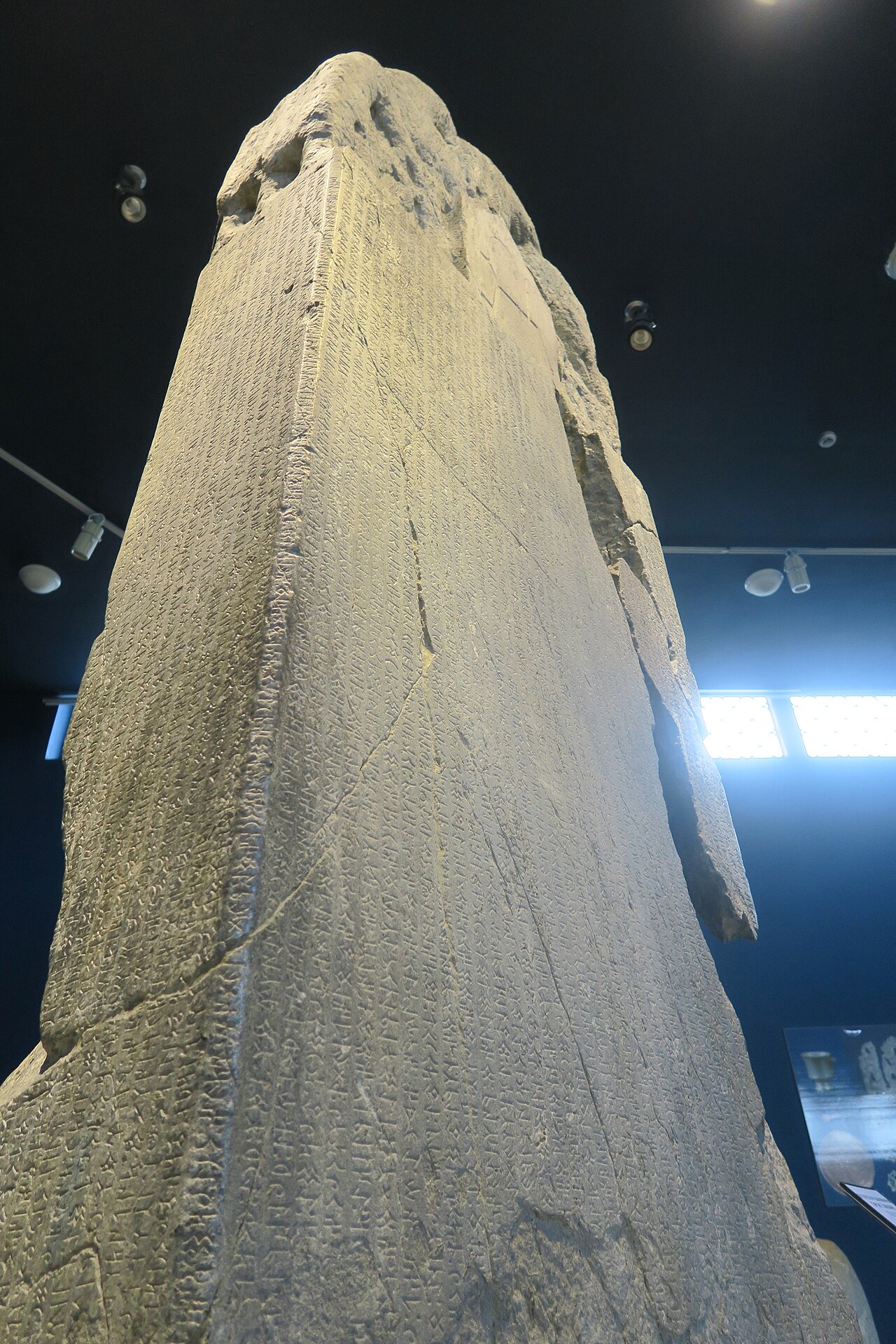
The Kül Tigin memorial stele in the Orkhon Valley, Mongolia, covered with 8th-century Old Turkic runic script (Vezirtonyukuk; CC BY-SA 4.0; Wikimedia Commons)
Name and nature
The script is called the Old Turkic script, the Orkhon script, the Orkhon-Yenisei script, the Göktürk script or the Turkic runes. “Runes” refers only to a visual likeness to the Germanic runes — the two scripts are unrelated. The system has about 38–40 signs; it is an alphabet with some abugida traits. It was written right to left (in columns on some monuments), and words were separated by a colon-like mark.
Structure and vowel harmony
The script's most characteristic feature is its close fit to Turkic vowel harmony. There are few vowel signs (about four for eight vowels), but many consonant signs come in two “synharmonic” series — one for back vowels, one for front. So the consonant sign itself already carries information about the vowel that follows. The very same back-vs-front vowel opposition that the Estonian Tatar alphabet keeps in the pairs a–ä, o–ö, u–ü, õ–i was built into the Turkic script 1,300 years ago.
Variants — and our peoples
The script has several regional variants:
Orkhon — the classic form, 8th–10th centuries in Mongolia (the Second Turkic and Uyghur Khaganates);
Yenisei — the Yenisei Kyrgyz inscriptions in Siberia; by some held to be older than the Orkhon form;
Talas — a Yenisei derivative in Semirechye, with 29 identified letters;
Eurasiatic variants, incl. Don (the Khazars), Kuban (the Bulgars) and Tisza (the Pechenegs).
It is here that the script touches our story directly: it was also used by the Khazars and the Bulgars — the peoples of our deep history. The Turkic runiform script was not a distant Mongolian affair but reached the Don and Kuban steppe, the same world from which the Volga Tatars and the Mišärs grew.
Origin
The script's origin is disputed. Since Vilhelm Thomsen (1893) it has been held to derive from the Aramaic alphabet via the Sogdian and Pahlavi scripts (by some also under Kharosthi influence). The old tamga (clan-mark) theory — that the script grew out of local livestock brands — is widely rejected, since the early tamgas are too thinly attested.
Use and displacement
The script was used in the 8th–10th centuries across the Turkic world: in Mongolia under the Second Turkic Khaganate and the Uyghur Khaganate, in the Yenisei basin, the Altai and Xinjiang. The whole Old Turkic corpus is about two hundred inscriptions plus a few manuscripts, mostly epitaphs. The script was deciphered by Vilhelm Thomsen in 1893, which founded Turkology. It was later displaced by the Old Uyghur alphabet and then the Arabic script.
Today
The Old Turkic script was added to Unicode in 2009 (block U+10C00, with separate Orkhon and Yenisei signs). As a symbol it lives on in Turkic identity — for instance on the Azerbaijani 5-manat banknote. The line of Turkic literacy runs on from it through the Old Uyghur, Arabic and finally Latin scripts; the Estonian Tatar alphabet is the newest link in that ~1,300-year story (see Proto-Turkic and the Codex Cumanicus).
Sources
This article draws on: Old Turkic script; Orkhon inscriptions; Old Uyghur alphabet (English Wikipedia); ruunikiri (Estonian Encyclopaedia). The script's origin and the Yenisei/Orkhon age question are flagged as open in the text. See also this knowledge base's pages: the Orkhon inscriptions, the Turkic Khaganates, the Uyghurs and Proto-Turkic.