A genetic profile and the Mišär heritage
A deep analysis of one Estonian Biobank (geenidoonor.ee) profile. The profile owner's mother is a Mišär Tatar and father an Estonian. The analysis splits the profile into two parental halves, reconstructs the maternal Mišär half, ties each component to documented Mišär Tatar origins and genetics, and marks clearly what is certain and what is interpretation.
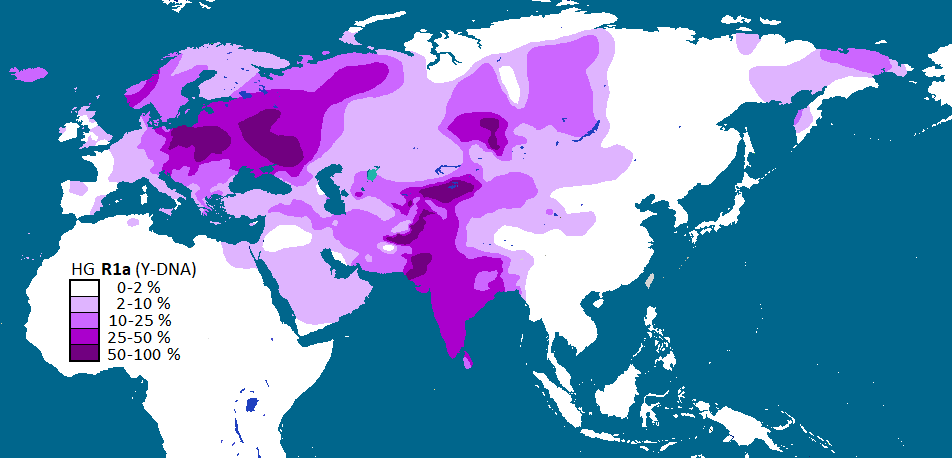
Distribution and frequency map of Y-DNA haplogroup R1a (M420) among indigenous populations, from Europe through Central Asia to South Asia (Maulucioni; CC BY-SA 4.0; Wikimedia Commons)
The profile
Eastern Europe 58.4% · Finland 23.3% · Northwest Europe 5.1% · South Asia 4.7% · East Asia 3.8% · Middle East 2.7% · South America 1.9%.
On method: the biobank reports similarity to reference populations, not a direct ancestry percentage. Small shares (a couple of percent) carry large uncertainty and should be read as a tendency, not an exact figure. What follows is interpretation, not a diagnosis.
Two sides: an Estonian father and a Mišär mother
About half the ancestry comes from each parent. The large European core — Eastern Europe 58.4% + Finland 23.3% + Northwest Europe 5.1% ≈ 87% — fits both at once: Estonians score high Eastern-European and Finnish similarity (Finno-Ugric peoples), and the Mišär Tatar genetic base is also largely West-Eurasian (a Srubnaya-type steppe core plus a strong Finno-Ugric substrate). That is why the small non-European shares are the telling ones: on the biobank charts the ESTONIAN reference sits essentially at zero for them. They almost certainly come from the Mišär mother.
Reconstructing the maternal half
If the Estonian father contributes roughly zero to the non-European shares (as the ESTONIAN reference suggests), then on the maternal side — where they make up the whole inheritance — they are about twice their whole-profile value:
East Asia ~7–8% · South Asia ~9–10% · Middle East ~5–6% · South America ~4% (mostly a shadow). In total the eastern/steppe component of the Mišär maternal half is about a quarter, and the West-Eurasian part about three quarters.
This ~75/25 split matches the published Volga Tatar model almost exactly: autosomally about 70–80% Srubnaya-type + 20–30% East-Eurasian, with the eastern part slightly smaller in Mišärs than in Kazan Tatars. In other words, the profile owner's maternal half behaves exactly as an average Mišär Tatar should.
The most special shares — the Mišär fingerprint
East Asia 3.8%. The East-Eurasian (Ulchi-type / South-Siberian) component the Volga Tatars acquired from Kipchak and Golden-Horde-era steppe migration (about the 13th–14th centuries) — the genetic signature of the Turkic steppe. Anthropology (Trofimova) gives Mišärs ~11% South-Siberian Mongoloid type, less than Kazan Tatars. On the maternal side ~7–8% fits that range.
Middle East 2.7% (reference: Turkey, Syria, Iraq, Iran). Likely reflects the Indo-Iranian/Sarmatian substrate of the Volga Tatars and a broader West-Asian link; the Estonian reference is ~0. Small but characteristic of the Mišär side.
South Asia 4.7% (Sri Lanka, Bangladesh, Pakistan). The bridge is the ancient steppe. The Reich lab's 2019 study (Narasimhan et al.) showed that Sintashta and Andronovo steppe-pastoralist ancestry (Steppe_MLBA) entered South Asia after 2000 BCE and spread the Indo-Iranian languages — and the same steppe profile is found in Bronze Age Eastern Europe. The same Sarmatian steppe layer at the base of the Volga Tatars creates similarity to South Asian populations. It does NOT mean a direct South Asian ancestor, but a shared steppe origin that branched thousands of years ago.
South America 1.9% — almost certainly a statistical shadow, not real Native American ancestry. Native Americans share an ancient North Eurasian (ANE) and Siberian ancestor with the same source that feeds Turkic-Siberian peoples. A small East-Eurasian/Siberian signal thus leaks into the South American reference. This 1.9% is most likely a reflection of the SAME Siberian component that also gives the East Asia share — not an ancestry of its own.
The maternal line itself (mtDNA)
Because the Tatar side is the mother, the maternal line (mtDNA — the direct mother-to-mother lineage) is the most direct channel for this heritage. A study of Mišär Tatar mtDNA (Malyarchuk et al. 2010, 73 whole genomes) found ~84% West-Eurasian haplogroups (H 28%, U 17%, HV 11%, J 8%, T 7%, K 6%) and ~16% East-Eurasian (A, C, D, G, M7, M10, N9a, Y, Z), rising to 24% in some districts. The practical implication: there is a meaningful chance that the profile owner's direct maternal line carries one of these East-Eurasian haplogroups — which would be the clearest, testable trace of the profile owner's eastern-steppe heritage. The exact haplogroup could only be established by a targeted mtDNA test.
Layers of ancestry on a timeline
The layers of the maternal heritage formed in sequence: (1) Ancient North Eurasians (ANE, >15,000 years ago) — a shared source for Siberians, Europeans and Native Americans alike (hence the South American shadow); (2) Yamnaya steppe pastoralists (~3000 BCE); (3) Sintashta/Andronovo (~2000 BCE), who carried Indo-Iranian languages and steppe genes into both Eastern Europe and South Asia; (4) Srubnaya on the Volga steppe — the Mišär West-Eurasian base; (5) the Finno-Ugric Meshchera substrate plus the Kipchak/Golden Horde Turkic layer (c. 13th–15th c.), from which the Mišär people were born; (6) in the 19th century the Mišär merchants migrated from near Nizhny Novgorod to Estonia; (7) the profile owner.
Mišär Tatar origins — what science says
The Mišär Tatars formed in the forest-steppe west of the Sura River, around the Oka tributaries (the Meshchera region), among Finno-Ugric peoples. From about the 11th century nomadic groups moved in; in the Golden Horde period Kipchaks built strongholds there, and the ethnic character was finally shaped around 1400–1500 in the Qasim Khanate. There are several origin theories: a Finno-Ugric Meshchera substrate (Tatarized Finno-Ugrians), a Turkic Meshchera, a Hungarian/Magyar link (the name-forms Mišär ~ Madjar ~ Magyar), and Kipchak dominance. The common thread: the Kipchak role was somewhat greater than for the Kazan Tatars, and the Mišär western dialect preserved archaic Kipchak features.
Y-chromosome (paternal-line) haplogroups in Mišärs: J2 ~26%, R1a ~23%, N ~13%, R1b ~9% — a mix of West-Asian (J2), steppe/Indo-European (R1a) and Finno-Ugric (N) lineages. Note: in this profile the paternal line is the Estonian one; the Mišär Y-DNA statistics describe the Mišär people as a whole, not this profile's paternal line.
The layers in this knowledge base's peoples
The mixed layers of this profile can now be given named peoples — exactly those described in the study “Khazars, Kipchaks, Burtas: On the Ethnic Ancestors of the Nizhnii Novgorod Mishar Tatars” (2018) and covered by this knowledge base's pages. The three disputed ancestors map well onto the profile's three layers:
The Burtas — this middle-Volga substrate people sits exactly at the profile's seam. Their own origin is open: the Finno-Ugric (Mordvin) thesis ties them to the profile's large Finno-Ugric base, while the Iranian (Alanic) thesis ties them to that small Middle-Eastern / Sarmatian signal. The Burtas are thus a genetically two-sided link — just like the profile.
The Bulgars — the western-Eurasian (Srubnaya-type) base reached the Volga Tatars partly through Old Great Bulgaria and Volga Bulgaria (the Oghur-Turkic branch). In the Golden Horde the Bulgar and Kipchak lines fused — the two roots that coincide in the profile.
The Kipchaks and the Turkic steppe — the East-Eurasian (South-Siberian) share came with the Kipchak and Golden-Horde-era steppe migration. Our Turkic Khaganates page notes that a genetic study of the ruling Ashina clan pointed to Northeast Asian ancestry and that Turkic spread partly by cultural diffusion — the same small East-Eurasian signal in the profile is the genetic echo of that steppe layer, not a large migration.
So the profile's “special” shares are not random: each has a name and a story in this knowledge base. The East-Eurasian share leads to the Turkic steppe world, the Middle-Eastern and South-Asian shares to the Sarmatian steppe layer, and the large western-Eurasian base to the Bulgar and Finno-Ugric Meshchera substrate. The whole picture is given by the formation map and the Estonian Tatars' timeline.
What this analysis can and cannot say
It can: confirm the profile is consistent with half-Estonian, half-Mišär ancestry; show that the small eastern shares behave exactly like the Mišär steppe heritage; explain WHY South Asia and South America appear (shared steppe and ancient Siberia, not direct ancestry). It cannot: give exact ancestry percentages (these are similarity scores, not admixture); confirm individual ancestors; replace a targeted mtDNA or Y-DNA test. All percentages are approximate and the error margins on the small shares are wide.
Summary
The profile tells the owner's ancestry neatly. The large Finnish + Eastern-European core is where the Estonian father's and the Mišär mother's Finno-Ugric and West-Eurasian roots meet — which is why it dominates. The small special shares — East Asia, Middle East, South Asia and even that South American shadow — are the fingerprint of the Mišär mother's steppe heritage: the Turkic-Kipchak eastern steppe, the Indo-Iranian Sarmatian layer, and an ancient Siberian trace. The maternal reconstruction (~75% West-Eurasian, ~25% eastern) matches the average Mišär Tatar, and the profile owner's direct maternal line may carry the clearest trace of this story. The very story this knowledge base tells in words is also written in the profile owner's DNA.
Sources: the Estonian Biobank (geenidoonor.ee) profile; Wikipedia 'Mishar Tatars', 'Volga Tatars'; T. A. Trofimova's anthropological data; Malyarchuk et al. 2010 (Mišär mtDNA); Narasimhan et al. 2019, Science (steppe ancestry in South Asia); autosomal studies of the Volga Tatars (the Srubnaya/Ulchi model); Y-DNA haplogroup frequencies. The interpretation is the author's own; the small percentages are approximate. See also this knowledge base's pages: the Burtas, Old Great Bulgaria, the Turkic Khaganates, the Kipchak steppe and the Qasim Khanate.